SPIRIT
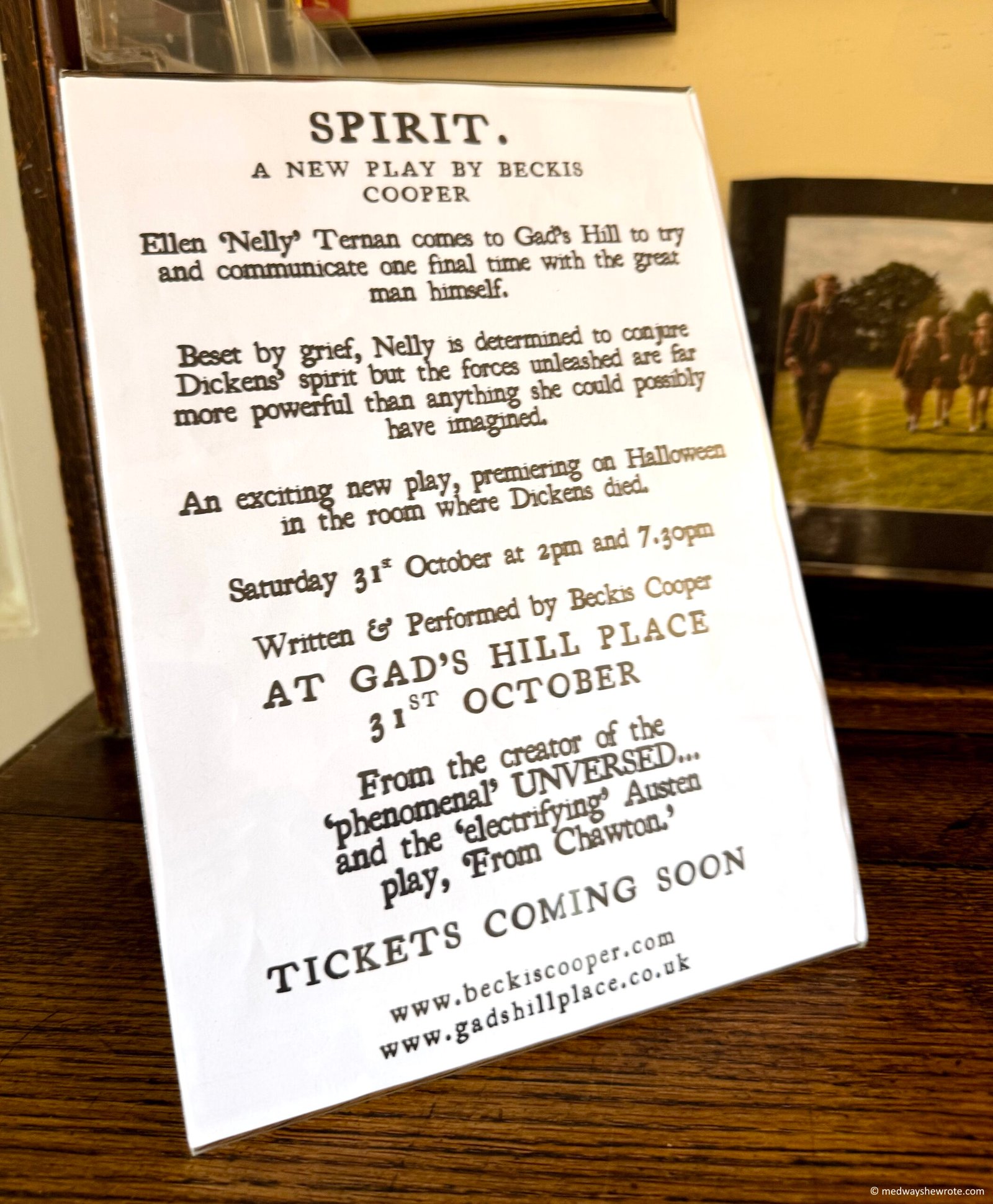
– Advertising poster for Spirit by Beckis Cooper
A new play by Beckis Cooper.
Ellen “Nelly” Ternan comes to Gad’s Hill to try and communicate one final time with the great man himself.
An exciting new play, premiering on Halloween in the room where Dickens died.
A new play about Charles Dickens and Nelly Ternan? At Gad’s Hill? To be premiered on Halloween in the very room where Dickens died?
Well, I couldn’t miss that!
Charles Dickens has been a theme of my life since I moved to Medway. You really can’t escape the man round here. It’s just as well I like his books.
But there’s someone else who’s becoming a theme of my life lately: Nelly Ternan, Charles Dickens’ mistress. I found out about her back in September at the Charles Dickens Museum. After that trip, I determined to do two things. One, find out more about Nelly Ternan, and two, visit Gad’s Hill Place, Charles Dickens’ house in Kent. When I saw the advert for Spirit pop up on Instagram a few weeks later, it felt like a perfect opportunity to do both in one go. I snapped up tickets immediately.
Today on Medway, She Wrote: A visit to Gad’s Hill Place, and a review of a brilliant new play – Spirit by Beckis Cooper. Enjoy!
A play about Charles Dickens and Nelly Ternan…


© Victoria and Albert Museum, London
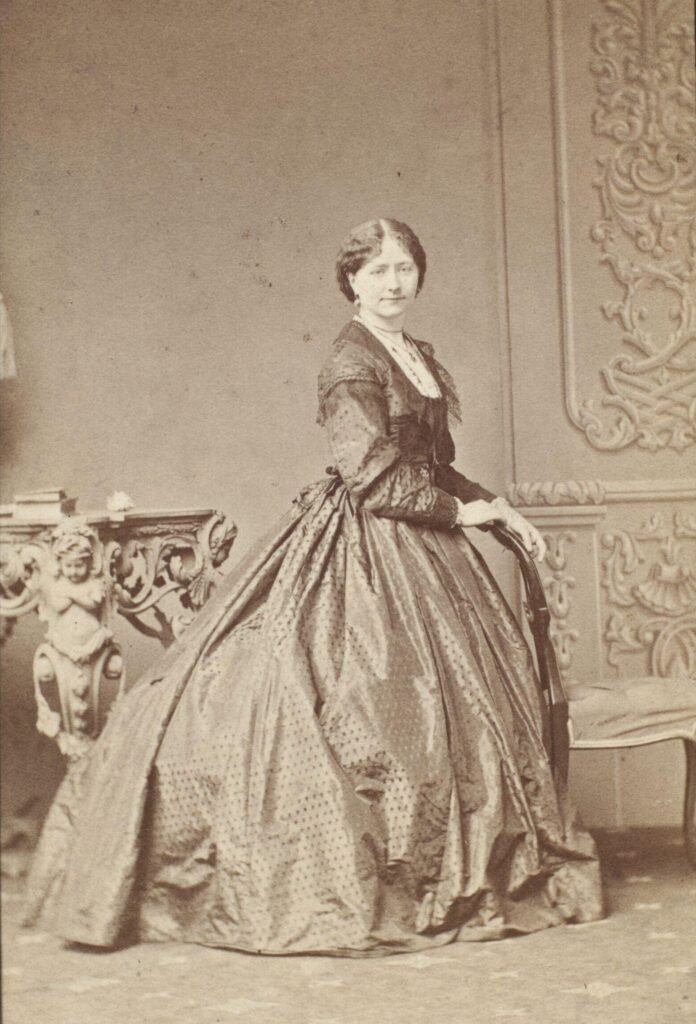
Nelly Ternan was born in Rochester, right here in Medway. The youngest daughter of a family of actors, her childhood was spent on the stage in theatres across the country. It was through acting that Nelly met Charles Dickens in 1857, when she was just 18.
Dickens saw Nelly on stage in London, and she was subsequently cast in a performance of his play, The Frozen Deep. Dickens fell in love with Nelly, paid for her to live in a house in Peckham, and apparently even took her on trips to France. Nelly was with Dickens during the Staplehurst train crash tragedy, and secretly attended his funeral in Westminster Abbey.
For a man of Dickens’ status, such an affair becoming public knowledge would be a scandal of epic proportions. That meant Nelly and Dickens’ relationship was kept majorly on the down-low. Even Nelly’s own son had no idea about it until decades later. The affair did, however, lead to Dickens leaving his wife, Catherine, in a public and pretty vicious separation. Catherine moved into a house in Camden Town, and Dickens decamped to Gad’s Hill Place.
At Charles Dickens’ house…
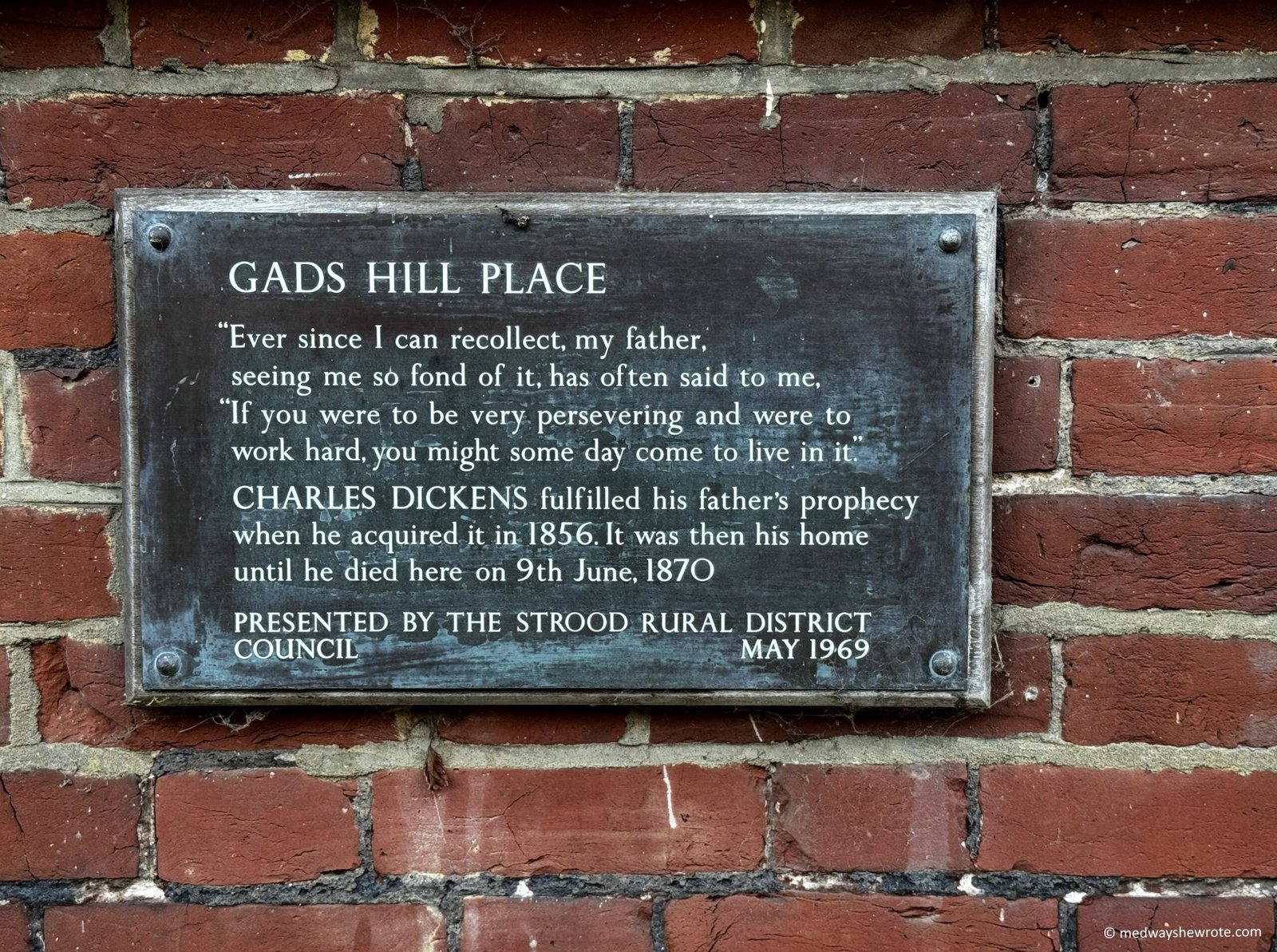
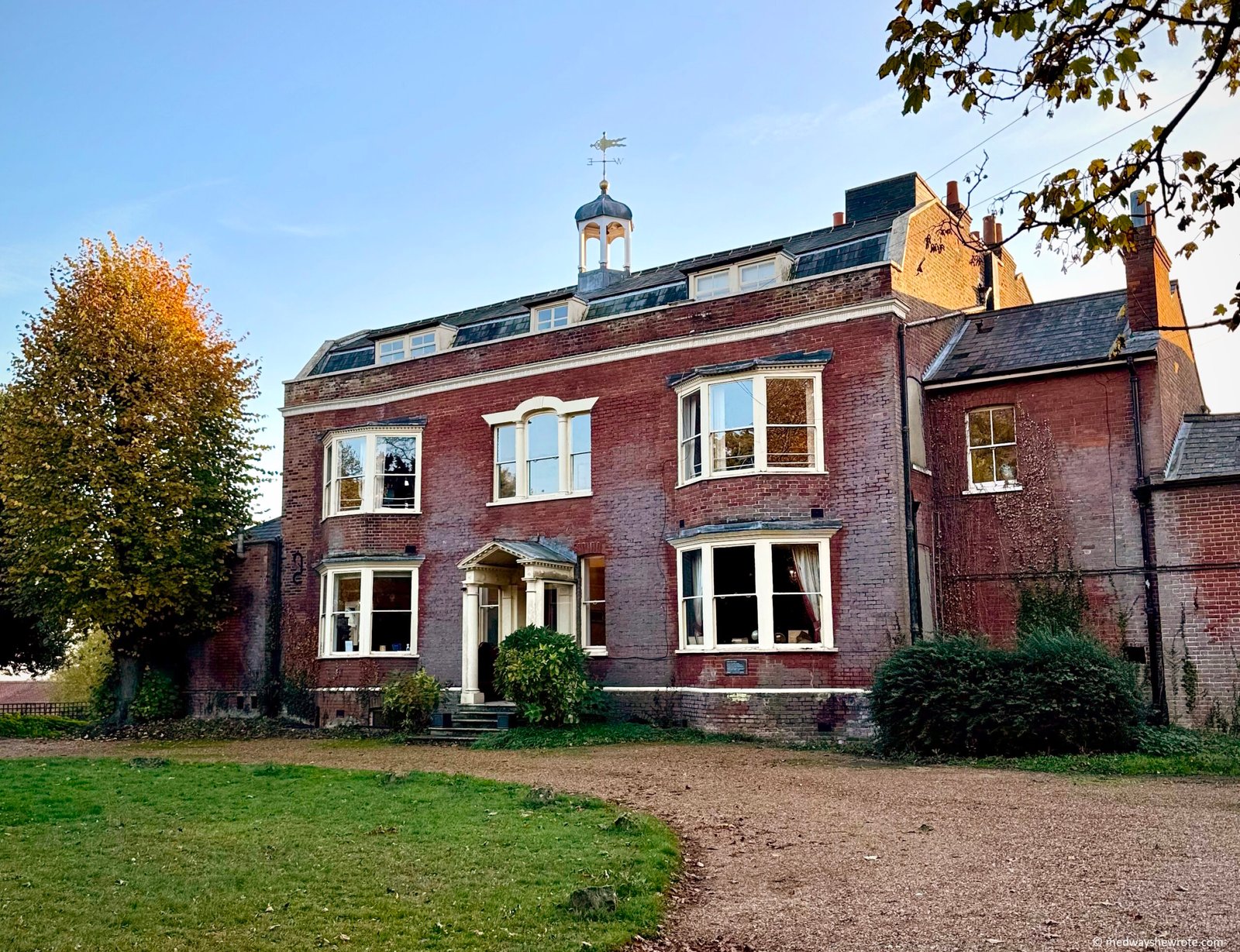
Gad’s Hill Place is a short drive from Rochester, and is the only home Charles Dickens owned outright. Dickens first saw the house when he was a young lad, and had yearned to live there ever since. In The Uncommercial Traveller, Dickens reminisces:
“When I was not more than half as old as nine, it used to be a treat for me to be brought to look at it…And ever since I can recollect, my father, seeing me so fond of it, has often said to me, ‘If you were to be very persevering and were to work hard, you might some day come to live in it.’”
Dickens bought Gad’s Hill Place in March 1856. He lived there for the last 14 years of his life with most of his children, and his sister-in-law, Georgina Hogarth. Gad’s Hill Place is where Dickens wrote A Tale of Two Cities, Our Mutual Friend, and Great Expectations, and where he died on 9th June 1870, aged just 58. His final novel, The Mystery of Edwin Drood, was published unfinished after this death.
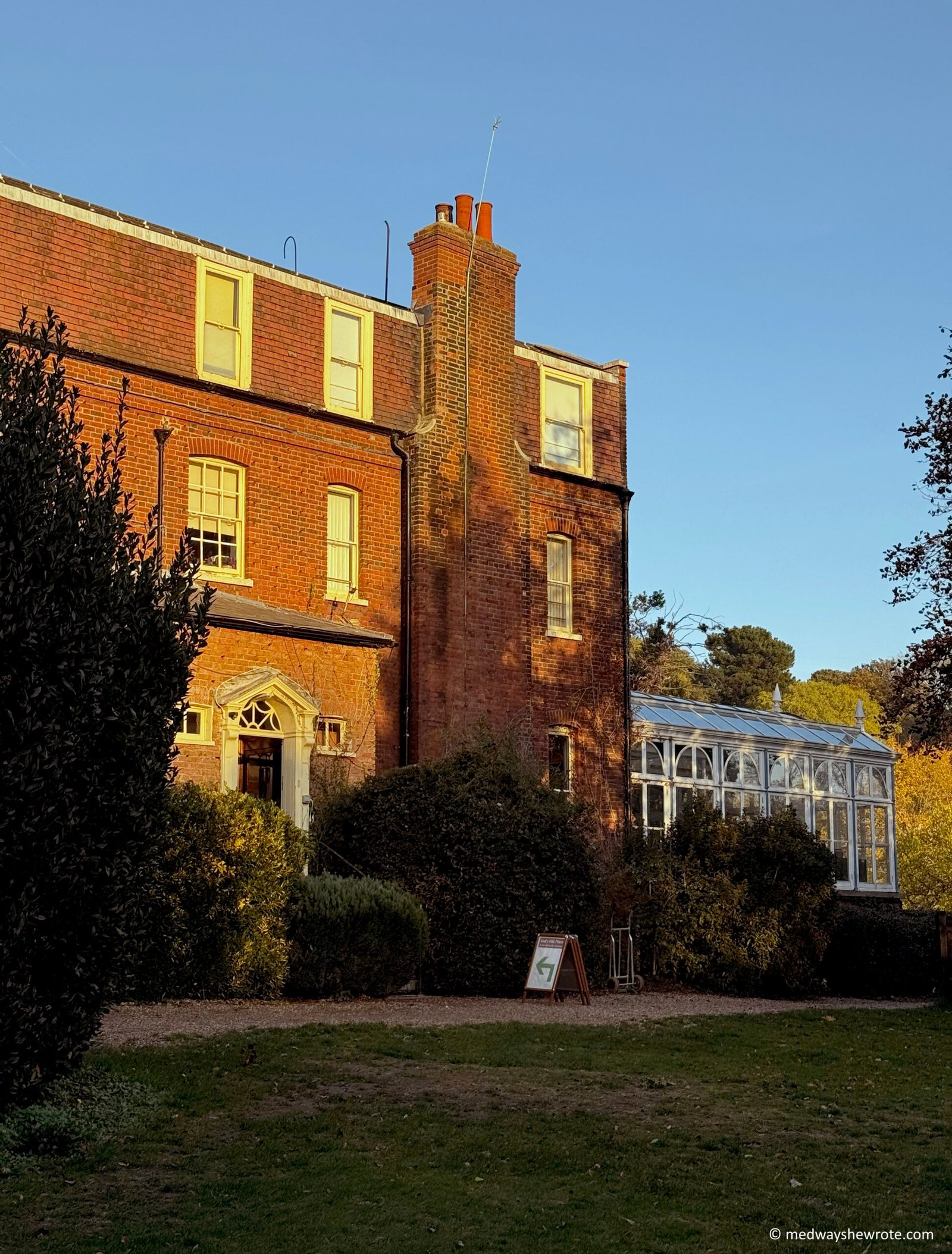
After Dickens died, financial difficulties forced the family to sell Gad’s Hill Place in 1878. In 1923, it was turned into a school, which it remains today.
From the outside, the house has changed little since Dickens’ time. Inside, being both a great author’s home and a school makes Gad’s Hill Place a curious mish-mash of styles. This is a house where eminent history meets everyday functionality.
Arriving for the matinee performance of Spirit, we are greeted with tea and cake, served in proper china cups and saucers by the lovely Gad’s Hill volunteers (you don’t get that sort of hospitality in the West End!) This is served in the school library. There’s few traces of grand Victorian décor here; instead it’s a bright, sensible reading space of the type seen in schools the world over. Today, it’s also a mini gift shop, with a selection of Dickens merch and books on sale.
(Yes, of course I bought a book. But if you read this blog regularly, you knew that already, didn’t you? Anyway, I needed it for Research Purposes.)
Charles Dickens’ study on the other hand, a room immortalised by Sir Luke Fildes’ watercolour, The Empty Chair, has been faithfully preserved. The study walls are lined with bookshelves, with even the back of the door designed to look like a bookcase. Dickens’ desk stands in front of the window, looking over the front garden where his writing chalet (now in Rochester) would once have stood. Standing in that space, surrounded by books, you feel Dickens is still very present at Gad’s Hill.
After soaking up the atmosphere of the study – and another round of tea! – we head into the dining room for the show.
Performed in the very room where Dickens died!
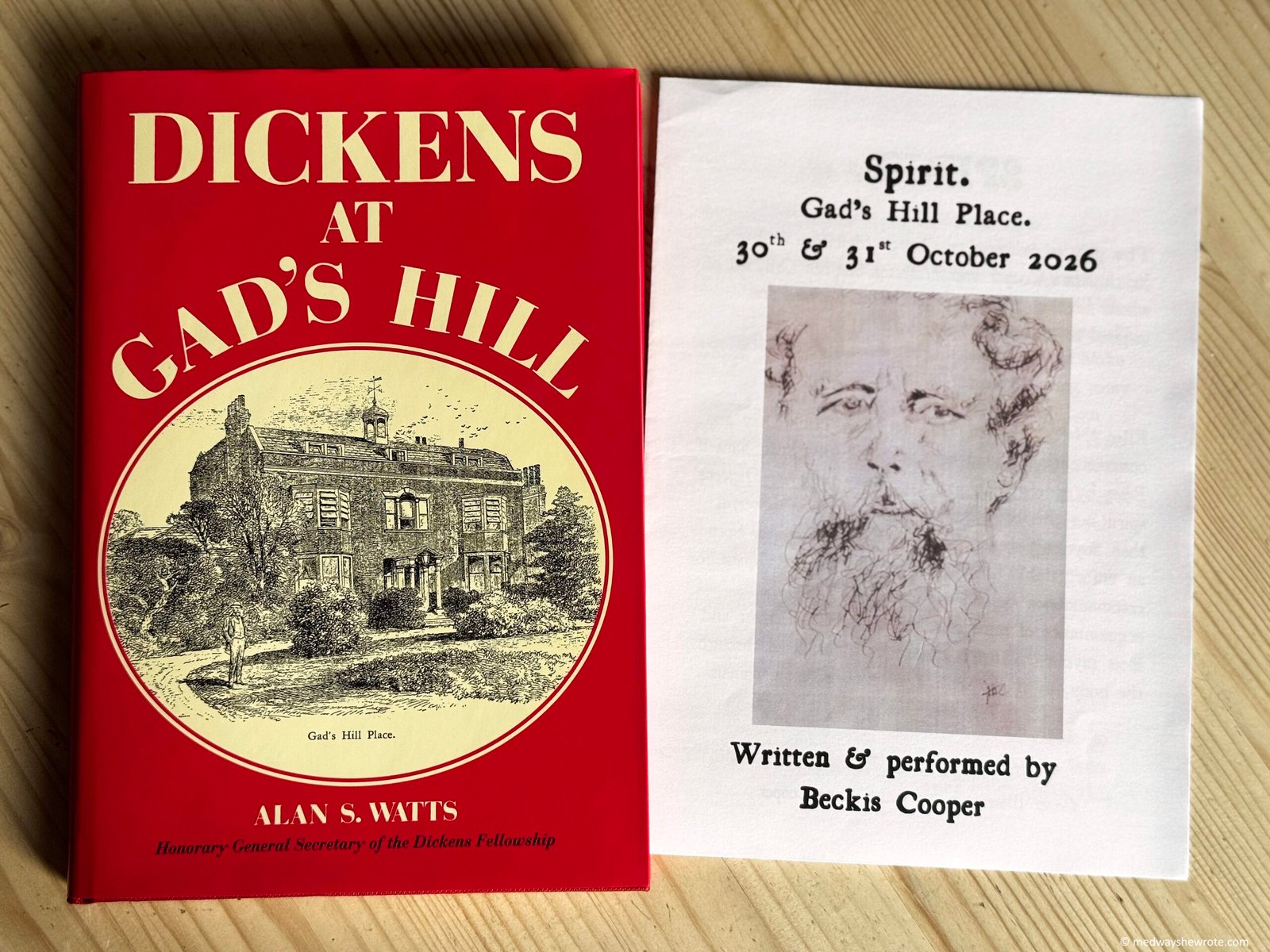
According to Dickens at Gad’s Hill by Alan S. Watts, Dickens furnished the dining room with a mahogany dining table and sideboard, and ten matching chairs upholstered in crimson Morocco leather. Posh! The room also had an enormous Turkish carpet and walls covered in portraits, including of the Dickens family. Dickens regularly entertained at Gad’s Hill, with guests including Hans Christian Andersen, fellow author and collaborator Wilkie Collins, his biographer, John Forster, and other writers, artists, historians and noted people of the time.
Although Dickens’ health had not been brilliant in the months prior, his death was unexpected. The only family member at Gad’s Hill Place when it happened was Georgina Hogarth. According to an account in the Manchester Guardian, Dickens became ill while having dinner in the dining room. Insisting that he simply had toothache, he refused to let Georgina call a doctor. He collapsed shortly afterwards and remained unconscious on a couch in the same room until his death the next day.
It’s a rare and exciting privilege to watch a new play about Dickens and Nelly Ternan in a room with such a historic connection to the great author. The space has changed since Dickens’ day though. It’s now a schoolroom that’s been used by generations of students, with painted yellow walls and a hardwood floor replacing the fancy portraits and Turkish carpet.
On one side of the room are two rows of seats for the audience. On the other, a great marble fireplace dominates the wall. In front of the fireplace is an ornate wooden desk cluttered with scrunched-up papers, a sepia photograph of Dickens, and other paraphernalia of the apparently recently departed author – the staging for today’s performance.
Into this room walks Nelly Ternan, a.k.a Beckis Cooper.
Spirit, by Beckis Cooper
In Spirit, Charles Dickens has only recently died, and a heartbroken Nelly Ternan (Beckis Cooper) has come to Gad’s Hill desperately searching for some last words or guidance from the man she loved. Remembering Dickens’ fascination with the supernatural and mesmerism, Nelly uses a variety of methods to communicate with him on the other side, encountering some of his most famous female characters along the way.
(Interestingly, despite pioneering the idea of the Christmas ghost story, Dickens didn’t believe in ghosts per se. He was, however, intrigued by the idea of the supernatural, and spiritualism more generally, and even sought out haunted houses. He also believed himself to be adept at mesmerism and regularly tried out his ‘mesmeric’ powers on family and friends.)
As Nelly Ternan, Beckis Cooper gives a multifaceted and sympathetic portrayal of a woman who is bereft by Dickens’ unexpected death, and bewildered at suddenly being left alone in the world. Her Nelly is a woman in a maelstrom of feelings – frustrated at being left without a final letter or note; resentful at having to keep her relationship in the shadows, playful when talking to Dickens, exhausted with grief, occasionally slightly manic – but consistently compelling.
Throughout Spirit, Cooper transforms from Nelly into a host of Dickens’ female characters who wish to make themselves heard. We are transported to Venice, where a bold Fanny Dorritt crows over her change in circumstances; down into the bowels of a convict ship where unhappy Alice Marwood awaits her fate, hellbent on revenge; to Satis House; and many other places.
All characters are played by Cooper, and each is distinct and nuanced, with their own voice, accents and mannerisms. Cooper’s Miss Havisham is so sinister as she commands an invisible Pip to come closer, that I find myself involuntarily leaning back in my second-row seat, trying – like Pip – to avoid getting any closer to this malevolent lady.
We spend only a few minutes with each woman, but thanks to Cooper’s impressive ability to distill the essence of their story, you don’t need to have read every Dickens novel to appreciate them. The characters’ narratives are deftly interspersed with that of Nelly herself. Cooper describes herself as a lifelong Dickens fan, and she clearly knows her stuff.
There could be no better venue for the premiere of this play than Gad’s Hill Place. Whilst Dickens’ dining room may look ordinary nowadays, it works rather nicely for Spirit. The comparative emptiness of the room amplifies the play’s themes of loss, memory and grief; the disarray of the cluttered desk emphasises Dickens’ sudden and unexpected departure.
Watching Spirit in the room where Dickens died naturally gives it a layer of eerie poignance, but when you have a powerful play, and an actor of Beckis Cooper’s talent, a show will triumph wherever it’s staged. Cooper gives a mesmerising performance, and her characters transcend the space. I was transfixed throughout.
Charles Dickens loved acting and trod the boards several times himself. If Dickens was watching this performance of Spirit from the other side (and I like to think he was), I reckon he’d be heartily applauding.
And finally…
Spirit will be on at The Painted House in Oxford on 14 November 2026. You can find out more about Beckis Cooper and her other shows, Unversed and From Chawton, on her website.
Gad’s Hill Place is open for tours from April to October, and for special events throughout the year.
I hope Spirit will return to Gad’s Hill Place. In the meantime, I’ll be keeping an eye out for what’s going to be on there around Christmas. And reading my lovely new book, Dickens at Gad’s Hill, of course!
Thanks for reading! If you enjoyed this post, you can subscribe to be notified of new ones using the subscribe button at the bottom of the page. You can also follow Medway, She Wrote on Instagram.
Leave a Reply